The Wind and the Arrow
“The mind at rest is the mind that has ceased to lie to itself about the extent of its power”
There exists within the human breast a ceaseless contest between the will to command and the yearning to rest. We crave mastery over our circumstances, yet long also for the release that comes from trust: trust in the wind, in fate, in Providence, in the mechanism that carries us forward while our hands lie still. But the truth, if we are honest, is that serenity is not born of control itself, but of the belief that control is either held or has been rightfully surrendered. The peace that men pursue so feverishly is found not in the balance between dominion and defeat, but at their extremes, where the will stands sovereign or where it kneels without deceit.
Between those poles, there is only the anxious tremor of half-command.
The Sail and the Wind
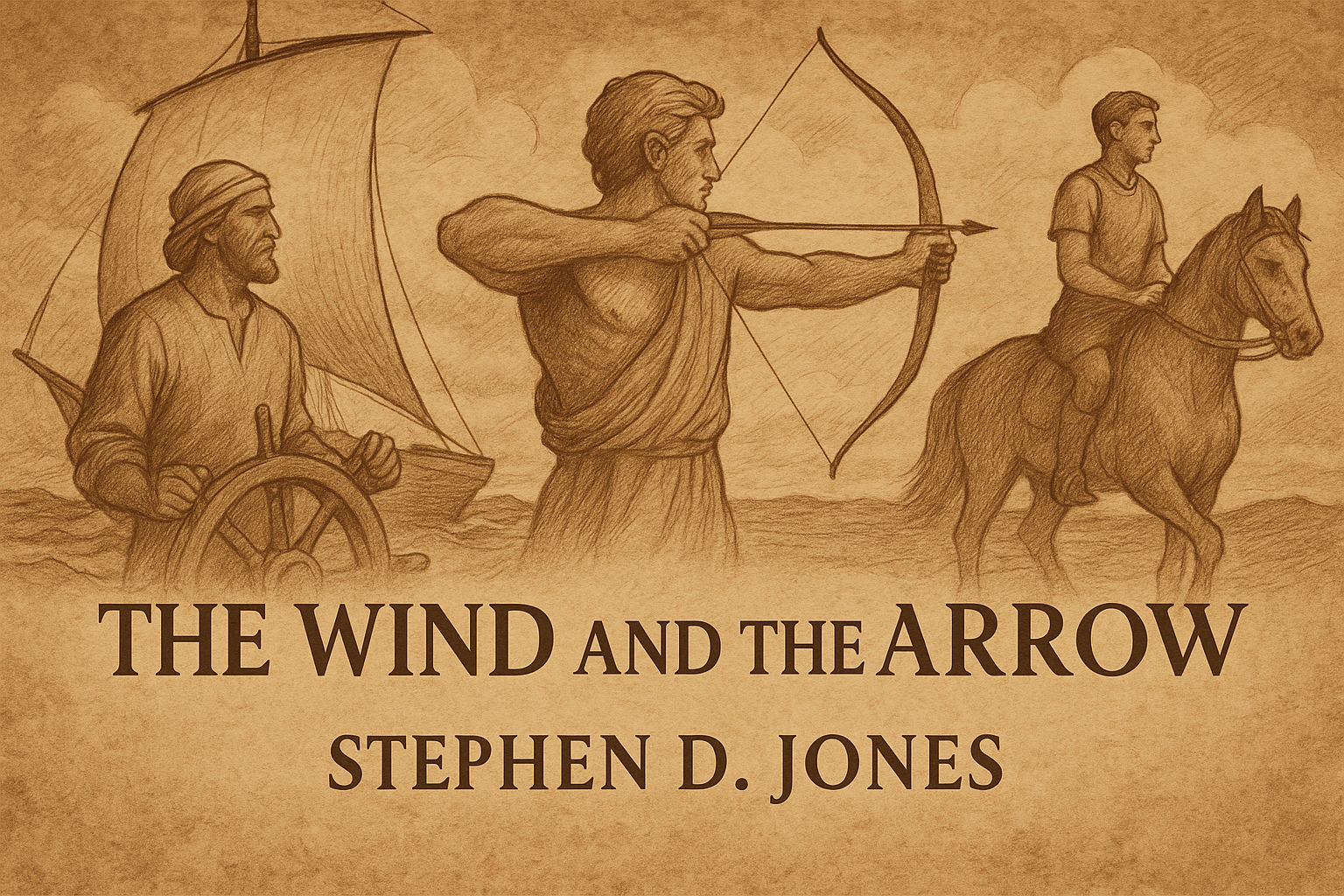
Consider the sailor upon the open sea. He trims his sail to the wind and sets his course by the stars. Once his ropes are fastened, he does not stand with white knuckles upon the helm. He allows the wind to bear him. The sea, vast and unreasoning, is not his servant, yet he does not quake beneath its power, for his trust is complete. He knows that he may seize the ropes at any instant, that the vessel still answers to his will. His serenity is born of confidence, not of constant interference.
This, then, is the paradox of peace: that one may command utterly by choosing not to act. The sailor’s mastery lies not in the continual tugging of ropes, but in knowing precisely when to release them. And should the wind change, his hand will act without hesitation; for one who has not abdicated responsibility, but merely delegated it, is never unprepared.
How many of our modern agitations arise from forgetting this truth? We clutch at every circumstance as though the mere loosening of our fingers would bring ruin. Yet the sailor knows better. He has learned that the world can be guided, but never gripped. His peace, though it may seem passive, is an act of profound confidence.
The Archer and the Arrow
There is another kind of stillness known only to the archer. When he has drawn the bow to its full tension, when his body has become one with the instrument, there comes a sacred instant between will and release. Once the arrow flies, his dominion ends; yet he feels no torment in that loss. He does not chase the arrow with his mind, for he has already given it everything he possesses.
Peace, for the archer, lies in the completeness of action. All that could be done has been done, and therefore the outcome, whether triumph or failure, no longer belongs to him. He has ceded his claim upon the future and lives entirely in the perfection of the moment just passed.
It is a hard lesson, that serenity begins where control ends. Yet there is wisdom in the archer’s detachment. He teaches us that the heart may rest once the hand has done its work, that anxiety is merely the residue of incomplete effort or dishonest surrender.
For if one looses the arrow while still doubting his aim, peace will never follow. The mind that has not earned its surrender cannot rest. It will replay the shot a thousand times, searching for what was withheld.
The Horse and the Rider
The same principle governs the bond between horse and rider. The wise rider does not haul continually upon the reins, nor crush his mount’s flanks with restless heels. He gives the beast its rhythm, its dignity. He guides by presence more than pressure. Beneath him surges strength far greater than his own, yet that power moves in harmony with his will because he neither fears it nor seeks to dominate it entirely.
Control, here, is a conversation. Firm, but never frantic. The horse trusts because the rider trusts himself. Should danger arise, the reins will tighten; until then, the two travel as one.
This is the image of true governance, both of others and of the self. The mind that must always tug at its own passions, that cannot let its instincts run without terror, will never know peace. But he who has tamed the inner steed may rest lightly upon the saddle, knowing that even in stillness, the creature obeys.
The Two Poles of Peace
From these images: the sailor, the archer, the rider; emerges a single law: peace is found only where the boundaries of control are known and honoured. Between those boundaries lies the torment of uncertainty.
The man who has conquered what he can conquer knows peace through sovereignty. He stands atop his citadel and surveys a realm ordered by his own hand. His rest is the rest of command fulfilled.
The man who has surrendered sincerely knows peace through acceptance. He bows his head to what he cannot master and finds freedom in the yielding. His rest is the rest of truth acknowledged.
But the man who dwells between these poles; who neither masters nor yields, will know neither peace nor mastery. He will grasp at the world like a drowning sailor clutching both rope and wave, uncertain which will save him.
To know peace, therefore, one must either prevail completely or yield completely. Every intermediate stance is a form of deceit, for it denies the limits of one’s power while refusing to embrace them.
The Burden and the Illusion
There is, within this, a subtler truth: what we call “stress” or “relief” often has little to do with the situation itself and everything to do with the belief of where control resides. The mind is calmed not by the removal of danger, but by the conviction that danger is being handled; whether by oneself, by another, or by some impersonal mechanism that requires no further vigilance.
The sailor’s peace does not arise because the sea is safe; it arises because he has trusted the rigging. The archer’s calm does not come from certainty of the target’s fall; it comes from certainty that his aim was true. The rider’s ease does not depend upon the absence of peril; it depends upon his bond with the creature beneath him.
So it is with life. The burden that crushes us is not always the weight of responsibility itself, but the inability to determine whether we have laid it down rightly. To delegate control, to God, to fate, to systems, to time; is to remove the feeling of burden, even if the actual risk remains unchanged. Humanity’s entire relationship with divinity, governance, and technology can be read through this lens: we yearn to place our hands upon something larger than ourselves, not to lose control, but to rest within the illusion that control persists without our continual labour.
The Middle Path of Restless Minds
Yet most men linger in the middle. They neither conquer nor surrender. They speak of faith but do not trust, of resolve but do not act. Their minds alternate between anxiety and apathy, as if the pendulum of doubt itself were their master. They will neither face the storm nor bow to it. And so they live forever in the uneasy calm before the first thunderclap.
They are like sailors who adjust their sails every moment for fear of losing speed, never realising that their constant meddling is what slows them. They are archers who release their arrows too soon, then curse the wind for misguiding them. They are riders who distrust the very creatures that carry them, pulling the reins at every step until both horse and man are weary.
Their torment is self-made: the torment of those who will not decide whether to command or to release.
The Act of Deciding
To live wisely, then, is to live decisively. One must discern what lies within one’s dominion and either master it fully or resign it wholly. Everything else should be cast away.
To master is not to obsess, but to bring order. To surrender is not to despair, but to consent to truth. Both acts are noble, for both are honest. The dishonour lies only in the cowardice of hesitation: in pretending to surrender while secretly plotting to retake command, or in pretending to control what one has already abandoned.
Peace, in the final reckoning, belongs to those who are whole in their choice.
The Sovereign and the Servant
The wise man, therefore, treats the world as both sovereign and servant. When his will is strong, he commands. When his strength is spent, he bows. In both cases, he remains himself. His serenity is unbroken because he knows which posture each moment demands.
It is not mastery that brings peace, nor submission; it is clarity. The mind at rest is the mind that has ceased to lie to itself about the extent of its power.
And in that clarity, something extraordinary happens: whether ruling or yielding, the individual becomes the same. The sailor’s stillness, the archer’s breath, the rider’s poise; all are expressions of the same interior calm. They are the gestures of a spirit that has learned to distinguish between what may be shaped and what must be endured.
The Restless Virtue
And yet, there are truths before which even the wise cannot bow without cost. Entropy is chief among them. To yield wholly to it is to become one with its silence. The peace it offers is not the stillness of a calm sea, but the stillness of a drowned one.
The soul, if it is to remain alive, must sometimes choose unrest over harmony. For there exists a kind of restlessness that is holy: the agitation of the living against the slow drift towards nothingness.
If one’s philosophy teaches peace by surrender, yet one’s spirit recoils from surrender, it may not be error that causes the recoil but truth. For not all disquiet is a flaw in the mind; some is the voice of that inner fire by which existence asserts itself.
To wrestle with the inevitable is not foolishness, provided the struggle affirms something greater than the pain it brings. The man who fights entropy does not believe he can win, only that he must bear witness to what is worth preserving. He contends not for victory, but for meaning.
The arrow may never pierce the stars, yet the archer’s dignity lies in loosing it heavenward. The sailor cannot calm the storm, yet his hands upon the ropes declare that the helm still answers to the living. And the rider, knowing full well that his steed must one day falter, yet rides on for the sheer grace of motion.
Yet no man may inherit another’s unrest. The lines that are worth dying upon differ for each soul, and wisdom lies in discerning where serenity becomes surrender of the self. One must know which causes merit turbulence, and which are but vanity disguised as valour. To some, peace is holy; to others, peace is the greater treason. Each must measure for himself where the stillness of acceptance ends, and the death of conviction begins.
To struggle thus is not to deny truth, but to honour it. For entropy may rule the universe, but it cannot rule the will that dares to oppose it, not even for a moment.
Therefore let it be said: peace is not always the summit. Sometimes the crown lies upon the brow of struggle itself. There are things whose decay must be resisted until our knuckles bleed, not because resistance will prevail, but because it is right to resist.
He who fights with no hope of victory may yet triumph in the eyes of eternity, for he has preserved that which even decay cannot touch: the unbroken flame of purpose.
The Final Lesson
So let us speak plainly: the world will not conform to our will. Storms will rise, arrows will miss, horses will shy. The measure of a man is not how perfectly he commands these things, but how gracefully he abides them.
Yet grace does not mean weakness. To bow sincerely to what one cannot control is as great a triumph as subduing what one can. In both cases, the will stands unbroken, for it has chosen its ground.
Let the one who seeks peace, then, do one of two things: face what vexes him until he conquers it, or yield to it until he no longer fears it. All other courses are half-measures, and half-measures belong to restless souls.
There is no peace in pretending to let go while the fingers still clutch the rope. There is no serenity in claiming control while one’s hand trembles upon the helm.
But there is infinite stillness in the archer’s release, in the sailor’s trust, in the rider’s gentle hand. For they have each understood the same truth in different tongues: that peace is not the absence of struggle, but the perfect alignment of will with truth.
Invicta voluntas.
— Dr Stephen D. Jones
#ThePhilosophyOfClay #TheRestlessVirtue #WillAndTruth #SovereignMind #StoicWisdom