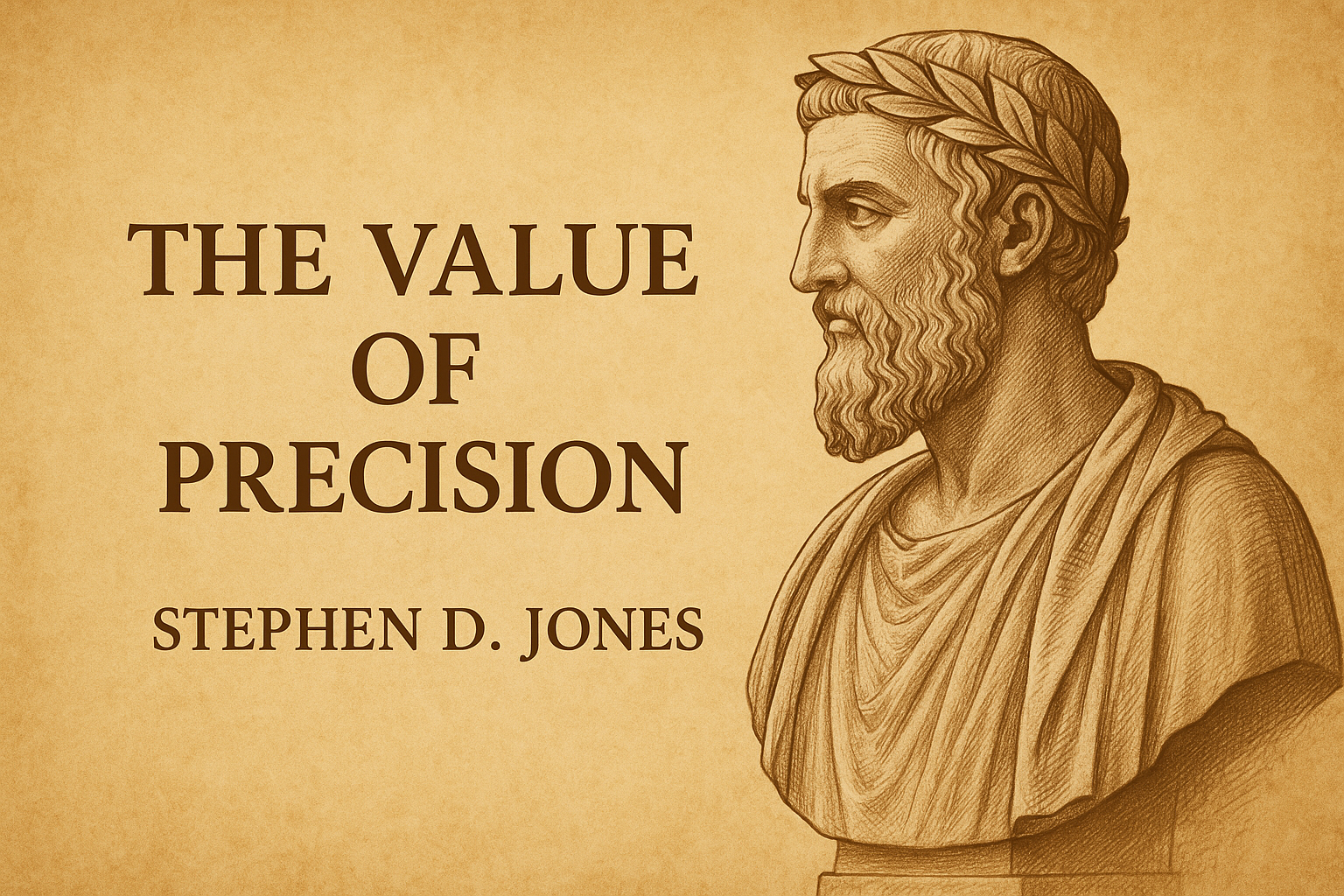
The Value of Precision
Clarity draws the blade across ambiguity. And where the blade falls, evasion ends.
There is a reason why most people speak in half-truths, soft qualifiers, and deliberately ambiguous statements: clarity is dangerous. When you speak with precision, you remove your escape routes. You close the doors behind you. You force the world, and yourself, to confront what you actually believe, not what you could pretend to have meant later. In a society that rewards plausible deniability and punishes certainty, clarity is not just rare; it is costly.
I. Why Clarity is Feared
Clarity limits plausible deniability. It strips away the protective layers of ambiguity that people use to insulate themselves from criticism or consequence. Once you are clear, your beliefs and intentions are exposed, and exposure invites challenge. Many fear that clarity will lock them into a position they may later regret, or worse, reveal that their thoughts were never coherent to begin with.
The world is more forgiving to those who say nothing than to those who say something with certainty and are later proven wrong. For this reason, people hedge. They prevaricate. They hide behind euphemism, implication, and nuance; not to reflect complexity, but to avoid commitment.
II. The False Virtue of Ambiguity
Ambiguity masquerades as intellectual sophistication. Entire institutions are built upon the illusion that refusing to commit is a sign of depth. But this is a lie. Wisdom is not the refusal to speak clearly; it is the ability to do so and to bear the consequences.
When you cannot be understood, you will not be followed. When you are not followed, you cannot lead. And when you do not lead, you contribute nothing to the betterment of others. And you bind the horizon of your own development.
There are, of course, cases where ambiguity is strategic or necessary. Diplomacy, storytelling, and layered art all make use of it. But when ambiguity becomes the default mode of speech, it signals not sophistication, but fear.
III. Clarity as a Moral and Strategic Virtue
Clarity is not merely a rhetorical tool; it is a form of moral courage. Clear speech reflects clear thought, and clear thought reflects internal order. It is a declaration that you know what you mean, and you are willing to be known by it. You need not be correct in all things, but you ought to strive to be righteous wheresoever possible. The world cannot indulge mass uncertainty and inaction. In order for all of us to move, some of us must move. Will all of our moves be correct? No. Still, better the possibility of failure than the indignity of stagnation.
In leadership, clarity creates alignment. In crisis, it creates stability. In disagreement, it creates respect. People do not have to agree with you to trust you. They only need to know where you stand. That is the true power of clarity.
When you speak clearly, you make yourself legible to others. They can choose to walk with you or stand against you. But either way, they are responding to the real you; not a fog of impressions, intentions, and conditional subtext. In a society where the need to be seen is actively fostered, speaking with clarity offers a unique opportunity to be seen, and to have earned the privilege rightly.
IV. The Personal Cost
Clarity invites resistance. It makes you easier to attack. It makes you responsible not only for what you have said but also who you were when you said it. But it also makes you stronger. With every act of precision, you refine your thinking. You begin to fear less. And in time, you become someone whose words are not just heard, but remembered. To speak clearly is also an act of service, enabling those around you to make informed decisions. If the world is to be uncertain, do not add to it with half-truths and malformed thoughts.
If you want to matter, you must be willing to be misunderstood. You must be willing to lose, to offend, to be doubted. Because the alternative is to live in a state of suspended expression, where you never say what you mean, and therefore, never become who you might have been.
V. Actionable Insight
Train clarity like you train muscle:
• Write often. This practice of rigor will bring clarity.
• Speak deliberately. And mean every word.
• Accept correction. It is the cost of precision, not a sign of failure.
And above all, do not mistake ambiguity for wisdom. True wisdom is courageous enough to be understood. And strong enough to stand by what it said.
Fiat lux.
— Dr Stephen D. Jones
#Clarity #Leadership #Integrity #PhilosophyInPractice #MentalDiscipline