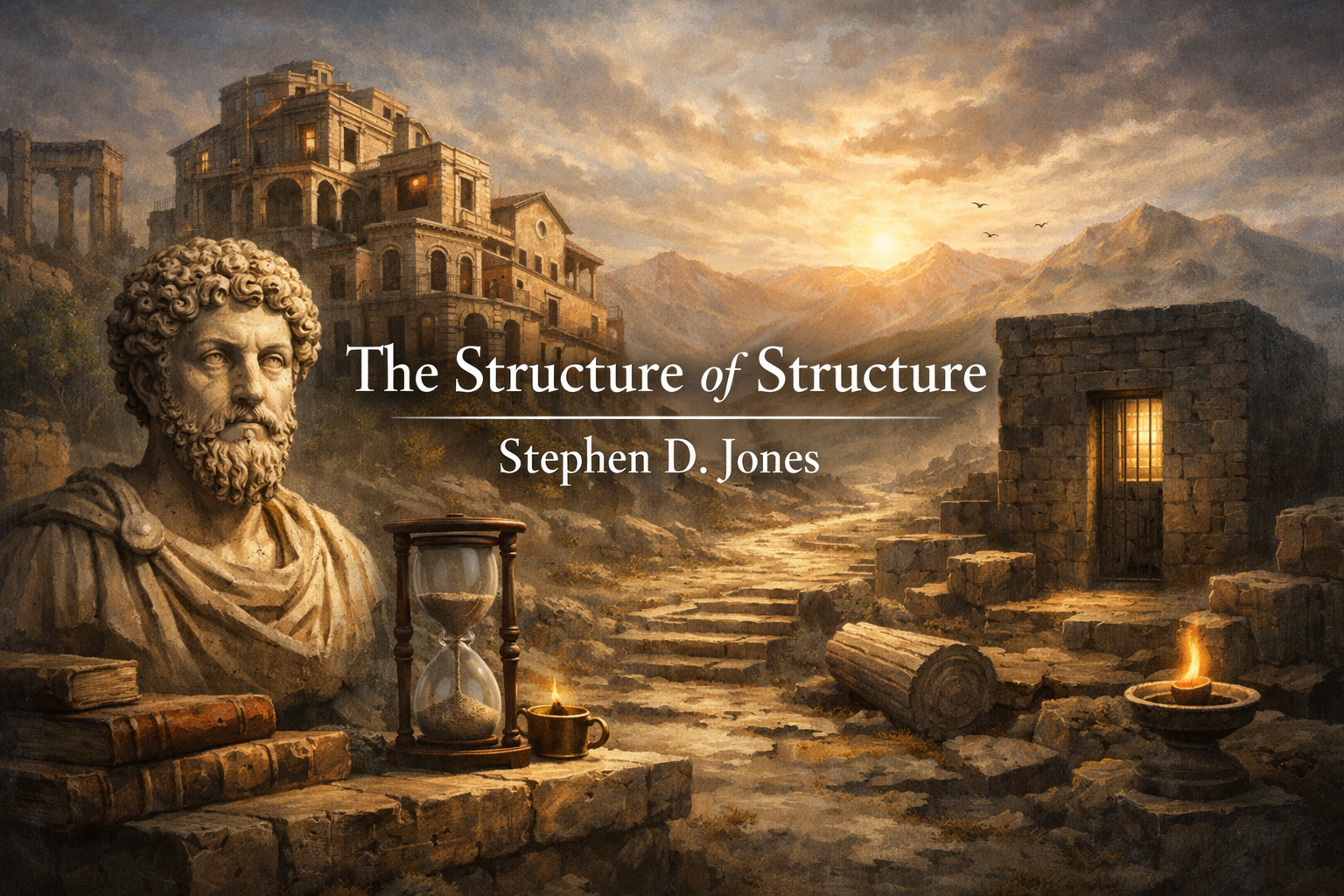
The Structure of Structure: On Complexity and the Cost of Keeping
A single man living alone in a house with one hundred rooms might be considered fortunate. However, if he is expected to maintain it by his own hand, then every extra room beyond what his life can sustain is a burden, not a blessing. More floors to clean, more windows to secure, more surfaces to dust, more corners in which decay may quietly begin. Such a house does not shelter him. It shackles him. His burden is not the same as wealth.
Yet the opposite extreme is no virtue either. Place that same man into a single-room cell and the absurdity remains, only now it is inverted. A life reduced to one room is not “simple”; it is cramped into a shape that cannot properly contain a human being. There is no separation between rest and work, between solitude and welcome, between disorder and dignity. In such a place, even peace becomes difficult, because the mind has nowhere to go. He would feel the anxiety that comes from confinement, and not the serenity that comes from minimalism.
Between these two failures, between the mansion that consumes its owner and the cell that shrinks him, lies a question that matters far beyond architecture: how much complexity is enough to live well, and how much is so much that life becomes maintenance? Where, precisely, is the line where a structure stops serving a man’s Will and begins quietly feeding upon it?
The Cost of Keeping
The cost of keeping is not simply the time required to clean what is dirty. It is the total burden of sustaining a structure in a usable state across time. It includes the labour of maintenance, certainly, but also the attention required to notice what is degrading, the discipline required to prevent minor faults from becoming major ones, and the low-grade vigilance that attends anything which can be lost, broken, stolen, or allowed to decay.
A man does not pay this cost only with hours. He pays it with mental bandwidth, with planning, with worry, and with the subtle loss of freedom that comes from knowing that a thing left unattended will punish him later. A structure that is too complex does not merely demand work; it demands continuity. It insists that its owner return to it, again and again, to keep the whole contraption from slipping into disorder.
At first glance, one might assume that this cost grows linearly. Twice as many rooms should mean twice as much cleaning. Twice the surface area should require twice the effort. But this is true only in the narrowest sense, and only if the structure is already being kept in a stable condition. In real life, the cost does not scale like a ruler. It scales more like a living thing.
The intuition is understandable. If each room takes ten minutes to clean, then one hundred rooms should take one thousand minutes. That is linear scaling, and in controlled conditions it holds. But a home is not a controlled experiment. A home exists in time. It suffers weather, wear, small accidents, forgetfulness, distraction, fatigue. The nonlinear cost appears not because each room takes longer to clean, but because each room increases the probability of hidden problems, and because problems that remain hidden grow quietly, until they become expensive.
The reason is simple: maintenance is a network of obligations, and not simply a single task repeated. Each additional room is not merely more floor to sweep; it is another door to lock, another window to inspect, another space that can be neglected without being noticed, another set of surfaces that can harbour damp, dust, insects, mould, or decay. With each new segment of structure, the number of places where something can go wrong increases; and so does the number of checks required to keep disorder from accumulating unseen.
Worse still, neglect does not scale linearly either. If a man delays cleaning a single room, the problem is small. Delay cleaning many rooms, and now he is no longer “keeping house”; he is confronting a backlog. And backlogs behave differently from chores. They begin to compete with the rest of life. They create avoidance. They create guilt. They create the familiar sensation of being surrounded by things that are asking something of you. The structure becomes psychologically heavier because it is behind. And this is before we consider interactions between rooms, where one failure can create another: damp becomes mould, mould becomes illness, neglect becomes repair, repair becomes expense.
This is where nonlinearity emerges, and it emerges in a form that is recognisable: it is the difference between maintaining a thing and recovering a thing. Maintenance is steady effort. Recovery is crisis management. And the probability of requiring recovery rises sharply as complexity increases, because the number of failure points increases, and because the failures begin to hide from you.
To put it plainly: a small structure can be neglected and then easily restored. A complex structure can be neglected only briefly before restoration becomes a campaign. This is why the man with the sprawling home is often exhausted. He is exhausted by the sense that the work is never complete, and not by the work itself. He is exhausted because he feels as though any pause will be punished, and so he is denied respite.
The Line of Sufficiency
The line of sufficiency is drawn in a man; not on a floorplan.
It is tempting to ask, “How many rooms should I have?” because numbers feel clean, and the mind likes clean things. But the question is not numerical. It is ethical. A structure may be too large for one man and perfectly reasonable for another, not because one is wiser than the other, but because lives differ. Some men are solitary. Some men are fathers. Some men host, teach, lead, convene. Some men are stewards of others. Some men live quietly and need little. Some men live loudly and create enterprises that require space around them like a forge requires air.
And yet, despite these differences, the line itself exists for all men. It exists because human attention is finite, because time is finite, and because Will, though mighty, is not a magical substance. It can be strengthened, yes. But it can also be spent wastefully. It can be bled slowly by needless obligation until a man becomes the custodian of a life he did not mean to create, one he does not recognise.
Every man lives inside some structure, whether he built it deliberately or not. Some structures are made of timber and brick. Others are made of commitments, possessions, responsibilities, expectations, habits, reputations, and systems of thought. Each of these is a “room” in the invisible house a man inhabits. Each one demands something. Each one must be kept. Each one can be neglected. Each one can decay. And if the house grows large enough, he will begin to feel what the man with the mansion feels: the quiet weight of being required rather than prosperity.
Sufficiency, then, is not the same as simplicity. It is not the denial of comfort, nor the romance of austerity. It is not the modern performance of owning less so that one may signal virtue. Sufficiency is the point at which a man’s life possesses enough structure to hold him upright, but not so much that it bends his spine. It is the point at which his systems support his Will rather than siphoning it. It is where he can remain in command, not through constant vigilance, but through the quiet fact that the thing he has built is proportionate to the life he is living.
A man finds this line not by asking what others have, but by noticing what his life can carry without resentment. Resentment is a useful signal when it is not indulged as a complaint. It is a message. It often indicates that something in one’s life has begun to demand more than it gives, or that one’s maintenance debt has risen high enough that it is now consuming the very freedom it was meant to purchase.
And so the question becomes more intimate: when you step back and look at your own structure, your visible house and your invisible one, does it still feel like shelter? Or does it feel like something you are forever catching up to? When you wake in the morning, do you feel that your day is yours to spend, or already spoken for by obligations that multiply faster than you can satisfy them? When you rest, does your life remain stable, or does it immediately begin to punish you for the pause?
The line of sufficiency is found when a man can answer these questions without lying to himself. It is found when he can admit, plainly, where he is maintaining things that are no longer worth keeping, and where he is enduring confinement because he fears the labour of building what he truly needs. It is found where he chooses, deliberately, what will claim his time and attention, and what will not. Not because the world has declared those claims moral, but because he has measured them against the only real yardstick: the life he has, the time he has, the duties he has freely taken, and the Will he intends to preserve.
A man does not need to live in a hundred rooms to lose his freedom. He can lose it in ten. He can lose it in three. And conversely, he does not need great wealth to live with dignity; he needs enough structure to hold his humanity without crushing it. The goal is not to become small. The goal is to become sustainable: to build a life that does not require constant repair in order to remain inhabitable.
This is the line of sufficiency: where your structure still serves you, even on the days when you cannot serve it.
The Two Drifts
Most men do not wake one morning and choose bondage. They arrive there by drift.
They add one room. Then another. They take on one obligation more. They accept one additional responsibility. They purchase one more thing that must be stored, protected, maintained, insured, remembered. Each step is small. Each step appears reasonable. And so the structure grows the way a reef grows: silently, gradually, and with a kind of innocent persistence, until the man looks up one day and realises that what he called “building a life” has become “keeping a system alive.”
This is the drift into excess, and its danger is obvious once the damage is done. The man becomes caretaker to his own accumulation. He is rich in possessions and poor in time. He lives among abundance, yet feels a constant scarcity of attention. He is required everywhere, and therefore free nowhere.
But there is another drift, less discussed and often praised in its early stages: the winnowing away into insufficiency.
A man may begin to remove rooms from his life not because he has found sufficiency, but because he has become enthralled by an idea of purity. He wants to be unburdened, unentangled, untouchable. He mistakes the reduction of obligation for the strengthening of Will. He mistakes austerity for clarity. He begins to admire the feeling of having “no needs,” not realising that this admiration may be ego wearing the costume of wisdom.
The tragedy is that the beginning of this road is applauded. Friends call it “healthy.” Family call it “simple.” Even professionals, meaning well, may praise the early steps as progress: fewer commitments, fewer possessions, fewer attachments, fewer demands. And for a time, it does look like progress, because many men truly are carrying too much. The first rooms removed are often dead weight.
But the drift does not always stop where it should.
A man can remove not only burdens, but supports. He can strip away not only clutter, but the very partitions that allow a human psyche to breathe: space for rest distinct from space for labour, space for solitude distinct from space for fellowship, space for dignity distinct from mere survival. And because the removal is framed as “discipline,” the early warning signs are misunderstood. The narrowing of life is interpreted as strength. The shrinking of needs is interpreted as enlightenment. And the man, praised for his simplicity, may not notice that he has begun to live like a monk without having chosen the monastery for its true purpose.
Excess and insufficiency, then, are not enemies. They are siblings. Each is a mismeasurement of the same thing: what a man’s life can sustain without resentment, and what his nature requires without apology. One man builds too much because he fears vulnerability, and thinks walls will make him safe. Another man dismantles too much because he fears dependence, and thinks emptiness will make him inviolable. Both are attempting to protect the self. Both risk wounding it.
This is why the line of sufficiency must be found from within rather than received from without. The world will praise you for building, until you collapse beneath it. The world will praise you for simplifying, until it becomes clear that you have simplified yourself out of a life worth inhabiting. Moreover, those who applaud are not applauding you. They are applauding a projection of their own needs upon you. And this should not be trusted.
A man must therefore ask not what is fashionable, nor what is admired, but what is true: does his structure still shelter him, or has it begun to consume him? Does his simplicity still hold his humanity upright, or has it begun to confine him? Is he building a home for his life, or building a story about himself? Will he be able to dwell in this home for a lifetime, or will he find it insufficient in time?
And here is the ultimate truth that runs against our intuition: the root problem is not excess, nor simplicity. It is drift: how far one drifts towards either pole, relative to one’s own innate needs. That is what makes the prison or the paradise. What is Heaven for one man may be Hell to another. Only we can decide this for ourselves, for only we must live with the consequences.
Conclusion
The goal, ultimately, is not to reach a finished state, for no structure is ever finished. Rather, it is to move from being the caretaker of your life to being its architect. To build deliberately is to accept that every beam you place requires your shoulder to support it, and every wall you remove exposes you to the wind. A structure is right when it can endure your stillness.
There is no perfect number of rooms. There is only the honest structure that fits the shape of your specific character. Measure your life not by what you have accumulated, nor by what you have renounced, but by the stillness you feel when you stand in the center of it. Ask yourself the single, honest test: when you pause, does your life remain a home? Or has it become a creditor?
Est modus in rebus.
There is a measure in all things.
— Dr Stephen D. Jones
#PhilosophyOfClay #Sufficiency #Will #Agency #Minimalism