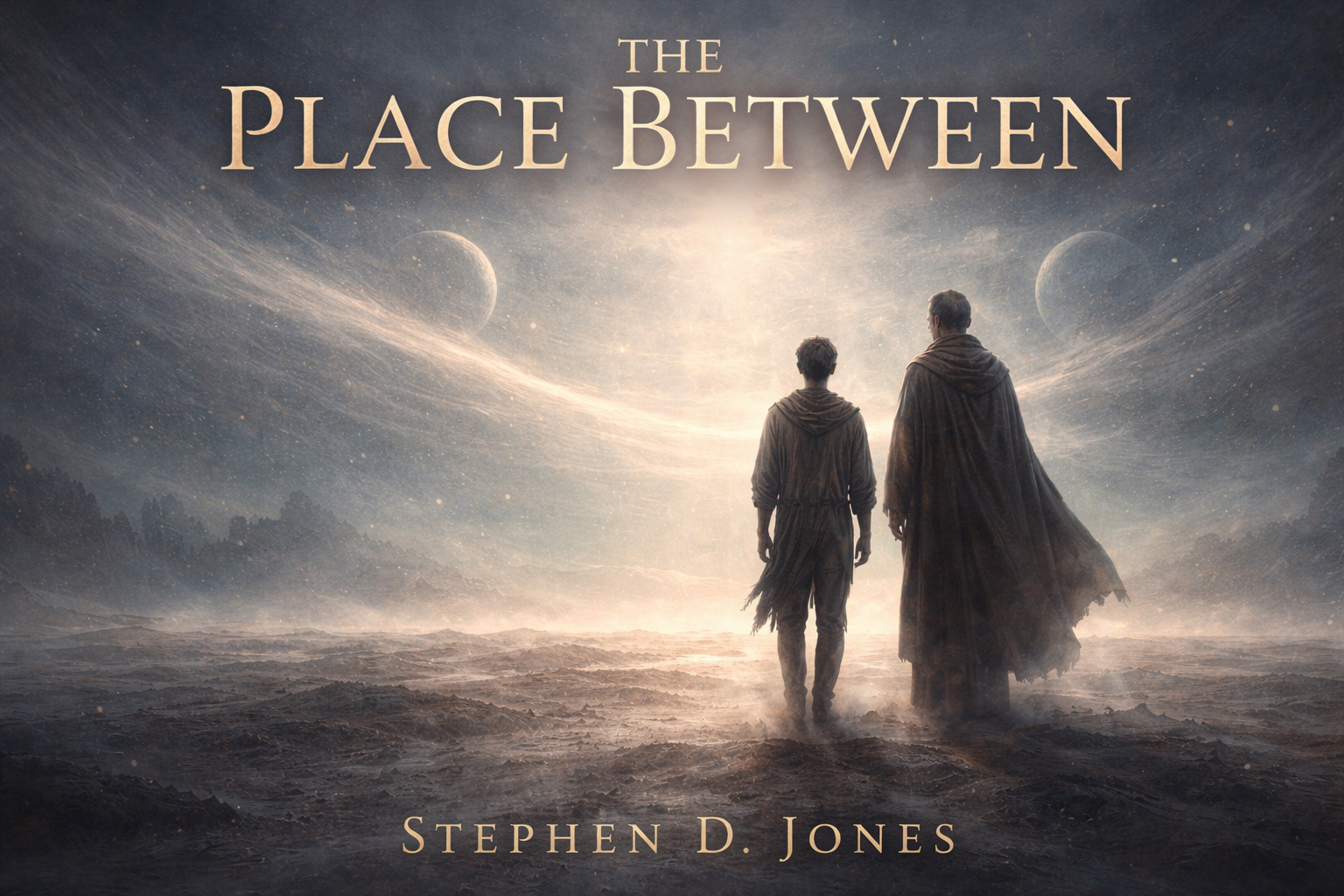
The Place Between
There is a place that is not a place.
It has no coordinates, no edges, no direction. Distance does not behave there. Time arrives, pauses, and forgets why it came. If one tried to call it a void, the word would fail. Because a void implies absence, and this place is full. Full of quiet. Heavy with waiting. And thick with the unspoken tension that exists just before something understands itself.
The ground, if it can be called that, is neither stone nor soil, but something more honest. It feels like memory made solid. When stepped upon, it does not resist, yet it does not yield. It accepts weight without complaint, the way truth does.
Above, there is no sky. There are layers instead: slow, translucent currents drifting past one another like thoughts that never quite become words. Light exists, but no source can be found. It glows softly from everywhere and nowhere, casting no shadows because nothing here needs to hide.
Far away, though far has little meaning, vast shapes move. They are not stars, yet they burn. Not planets, yet they turn. They resemble ideas too large to fit inside a single lifetime, revolving patiently, unconcerned with observation. They do not acknowledge the viewer, not out of indifference, but because acknowledgment would be a reduction.
This place was not created.
It accumulated.
Every question left unanswered. Every decision made without certainty. Every moment where a human being paused, however briefly, and felt the friction between who they were and who they might become. Those moments, shed like skin, drifted here. Over time, they layered. They formed this threshold.
And now, two figures stand upon it.
The First Arrival
The first does not arrive so much as remember himself into being.
He is younger. Not dramatically so, no child, no caricature of innocence; but unmistakably earlier. His posture is familiar: shoulders slightly forward, as though braced against a world that has not yet struck him hard enough to teach caution, but has struck him often enough to demand readiness.
His eyes move constantly, scanning the place with a mixture of curiosity and suspicion. He has not yet learned which questions are safe to ask, and so he asks them all silently, at once.
He wears no expression of shame.
Nor pride.
Only concentration. The kind worn by someone who believes, quite sincerely, that if he thinks hard enough, he can still solve everything in time. That if he is strong enough, he can shoulder any burden.
He does not know where he is.
But he knows, instinctively, that he has not arrived here by accident. He is anxious, unaccustomed to being summoned without judgement.
The Second Arrival
The second figure is already standing there.
That, perhaps, is the most unsettling thing.
He does not announce himself. He does not step forward from the light. He is simply present, as though the place itself has been leaning against him all along.
He is older, but not merely by years. Something else clings to him, something heavier and quieter. His stillness is not hesitation. It is containment. He has learned what happens when motion is wasted.
His face is calm, but not smooth. It bears the faint, indelible marks of understanding: creases not formed by age, but by repetition. By the act of seeing the same truths from different angles until denial finally exhausted itself.
When the younger man notices him, he freezes.
Not in fear.
In recognition.
The Moment Between Them
They do not speak.
They do not need to.
There is a moment, longer than comfort, shorter than dread; where each takes the other in fully.
The younger sees immediately what he has become afraid of becoming. Not weakness. Not failure. Responsibility.
The older sees immediately what he has lost. Not strength. Not conviction. Simplicity.
Neither smiles.
Neither frowns.
Because neither yet knows whether this meeting is a gift or an indictment.
Around them, the vast shapes in the distance continue their slow revolutions. The light remains steady. The ground does not shift. The place does not judge.
It merely holds.
And in that holding, something fragile flickers to life between the two men;
not forgiveness, not accusation, but possibility.
The younger man is the first to inhale.
The older man is the first to remain silent.
And somewhere, far beyond the edge of thought, patient and immeasurable;
a third presence waits,
watching not with eyes,
but with understanding.
He does not speak.
Not yet.
The Fish (That Waits)
The younger man breaks first.
Not loudly. Not defiantly.
But with the brittle impatience of someone who has been holding his breath for far too long.
His voice is not weak. But it is hurried, as though if he does not speak now, the chance might vanish. As though silence itself is a verdict forming around him.
“Did we make it?”
The question escapes before he can temper it. It carries with it a lifetime of effort compressed into a single syllable. Make it, not to comfort, not to happiness, not even to peace. Simply… to the other side of uncertainty.
He swallows.
“Did we try to do good?”
This one is quieter. Less ambitious. He does not ask if they were right. He asks if they were useful. If, when it mattered, their presence tilted the balance even slightly away from harm.
His hands curl unconsciously, fingers flexing as though still searching for weight to carry.
“Were we strong enough to help the ones we loved?”
Now the question fractures. Strength, for him, has always been a means, not an end. Strength was never about dominance; it was about being there when others faltered. About standing when standing was required. About not turning away.
There is a pause then. Longer. Dangerous.
The younger man looks at the older one fully now, really looks. As though reading answers in the lines of his face, in the stillness he wears like old armour.
And finally, the question he has been circling since the moment he arrived, the one he has not allowed himself to think aloud until now, breaks free.
His voice drops. Not to a whisper, but to something more honest.
Something afraid.
“Did I ruin everything? Did we succeed because of or in spite of me?”
The words hang between them, fragile and exposed.
Not a confession.
Not an accusation.
A fear: raw, unadorned, and unprotected.
The place does not react.
The vast shapes continue their patient revolutions. The light does not dim or brighten. The ground remains steady beneath their feet.
But something does change.
The silence deepens. Not in judgment, but in attention.
And for the first time since either of them arrived, the older man inhales slowly… deliberately… as though choosing not just how to answer, but who he will be when he does.
The River
The older man does not answer immediately.
He lets the question finish echoing. Not because he enjoys the silence, but because he respects what has been placed inside it. He knows that rushing now would cheapen something that cost too much to arrive here.
When he finally speaks, his voice is steady. Not rehearsed. Not cautious. Simply accurate.
“No,” he says.
Just that. At first.
“No. You did not ruin everything.”
The younger man exhales too quickly, as though relief has tried to seize the wheel. The older man notices, and continues before hope can outrun truth.
“But you did not save everything either.”
The words are not sharp. They are not gentle. They land with the dull, irrevocable weight of fact.
“We did not always know what we were doing,” he says. “And sometimes, knowing mattered. Sometimes it mattered a great deal.”
The younger man stiffens, bracing instinctively for blame. It does not come.
“You were not wrong,” the older man continues. “You were incomplete.”
He shifts his weight slightly, not away, never away; but as if grounding himself more firmly in the place.
“You were strong enough to help when help was possible. And when it was not… you learned what strength cannot do.”
The younger man’s jaw tightens. His eyes search the older face again, hunting for evasion. There is none.
“We helped some,” the older man says. “We failed others. Not because we did not care. Not because we were weak. But because caring does not grant omniscience, and strength does not undo consequence.”
A pause.
Then, deliberately:
“You do not owe me an apology.”
The younger man blinks.
“You acted with the tools you had,” the older man says. “With the understanding available to you at the time. You chose as best you could from inside the fog. It was never the responsibility of the son to raise the father. You were never expected to know everything. It was your responsibility to keep us alive long enough that we could learn something.”
He looks directly at him now. No armor, no distance.
“And I do not owe you absolution.”
The words are firm, but there is no rejection in them.
“Because absolution implies a crime. And what you committed was not a crime. It was a life.”
The younger man’s breath catches; not in relief this time, but in something closer to grief.
“What matters,” the older man continues, “is that you did not look away once you understood. That when the cost became clear, you did not pretend it wasn’t real. You carried it.”
His voice lowers; not in volume, but in register.
“And you brought it with you. All the way here.”
There is another silence. This one is different. Less brittle. Less afraid.
“You didn’t ruin anything,” the older man repeats. “But you did shape me. You left me with weight. With responsibility. With memory.”
He lets that settle.
“And because of that,” he adds, “I became someone who knows when to stop pretending. Someone who understands that doing good is not the same as feeling clean. Somebody who understands that clarity sometimes arrives too late, and that sometimes suffering has no meaning at all.”
The younger man swallows hard.
“If there is judgment,” the older man says at last, “it does not come from me.”
His gaze lifts. Not upward, not outward, but beyond.
“It comes later. From something that will not ask whether you were perfect… only whether you learned.”
He looks back.
"And you did.”
The place remains still.
But between the two men, something eases; not erased, not forgiven, but set down properly for the first time.
And far beyond the reach of either voice, the third presence continues to wait.
Not impatient.
Not displeased.
Simply watching…
to see what comes next.
Ripples in the Pond
The younger man’s relief does not last.
It never could have.
He listens. He absorbs. He understands more than he wants to, and something inside him tightens, sharp and indignant. The fear that brought him here hardens into something else.
Anger.
“But what about me?” he says suddenly.
The words come out louder than he intends. Not gravelly, but forceful.
“What happened to me?!”
He gestures at the older man: not accusing, not pleading, but demanding accounting.
“I gave everything,” he says. “I burned for it. I broke myself for it. I carried weight I didn’t understand because I thought it meant something.”
His voice trembles now, not with fear, but with the fury of someone who suspects he has been quietly robbed.
“Where did I go?”
The older man does not flinch.
He does not raise his voice. He does not rush to answer.
When he speaks, it is immediate. And final.
“Here you stand,” he says.
The words are simple. Unadorned.
“You became me.”
The younger man recoils as though struck.
“No,” he snaps. “That wasn’t a choice. That was done to me. Circumstance. Pressure. Responsibility. You don’t get to pretend that was consent.”
For the first time, the anger is naked.
“You don’t get to tell me I wanted the cost!”
The older man exhales, slow, steady. Not in frustration, but in recognition. He has heard this before. He has said it himself.
“You were forced into nothing,” he says.
The younger man laughs once: sharp, disbelieving.
“Don’t lie to me.”
“I am not,” the older man replies. “And that is why this hurts.”
He steps closer now. Not looming. Not crowding. Just close enough that distance can no longer do the work.
“You wanted this,” he says. “All of it.”
The younger man shakes his head, furious.
“No. I wanted the result.”
The older man nods.
“Yes,” he says. “And you knew the price.”
The younger man opens his mouth, and stops.
“You weren’t tricked,” the older man continues. “You weren’t cornered. You weren’t dragged.”
His voice remains level. Almost gentle, but not indulgent.
“You worked hard. You broke your back. You paid the bill in full.”
A pause.
“And you paid it for goods you would never collect.”
The words land heavily. Not as accusation, but as revelation.
“You knew,” the older man says quietly. “Not in detail. Not in clarity. But in shape. You understood that the work itself was the point. That the becoming mattered more than the having.”
The younger man’s anger falters. Not extinguished, but destabilized.
“You chose the path where the reward was the man,” the older man says. “Not the outcome.”
He meets the younger man’s eyes.
“And you chose it because you couldn’t live with yourself if you hadn’t.”
Silence rushes in again; thicker now, charged.
The younger man looks away.
Not defeated.
But seen.
“And I won’t insult you,” the older man adds, “by pretending that choice didn’t cost you something.”
The place remains still.
The vast shapes continue their slow, indifferent turning.
And somewhere beyond them both, the third presence watches closely now.
Not because a verdict is near,
but because the last illusion has begun to crack.
The Deep Water
The Present Self does not turn toward the Infinite presence at first.
He feels it before he acknowledges it. The way one feels pressure long before pain, the way the deep announces itself to the body before the mind can name it.
The Place Between changes.
Not visibly.
Not dramatically.
But fundamentally.
The vast shapes in the distance slow, or perhaps it is perception that lags now. The light does not dim, yet it grows colder, thinner, as though stretched across too much understanding. The ground remains steady beneath their feet, but its honesty deepens. It no longer accepts weight. It measures it.
The younger man feels it immediately.
His breath shortens. His spine tightens. Something ancient and unarticulated stirs in him: the instinct that once told small creatures to freeze when the sky itself seemed to lean closer.
This is not fear of harm.
It is fear of comprehension.
The Present Self finally turns.
There is no figure waiting for him.
No form.
No face.
No boundary that might be called a body.
There is only presence: layered, recursive, without edge. It does not occupy space so much as invalidate the idea that space was ever sufficient. It is not watching them.
It is including them.
The Younger Self understands then, with a clarity that terrifies him, that if this thing were a god, that would be a mercy. A god could be pleased, angered, reasoned with.
This is none of those.
This is what remains when the narrative falls away.
The Present Self does not kneel.
Not out of defiance.
But because kneeling would imply hierarchy. And hierarchy implies relevance.
He stands instead. Alone now, though the Younger Self is still there, witnessing: small, silent, suddenly aware that whatever he feared before was merely human.
The Present Self speaks.
His voice does not echo.
It is absorbed.
“I am not here to ask whether we succeeded,” he says.
The words feel thin as they leave him, but he does not retreat them.
“I already know the answer to that.”
The presence does not respond.
It does not need to.
The Present Self continues, slower now, more deliberate, as though each question must be shaped carefully enough to survive contact.
“Did we hesitate before cruelty?”
A pause.
“Not perfectly,” he adds, correcting himself before correction is demanded. “But honestly. Did we try to hesitate?”
The pressure increases. Not as threat, but as depth. The Younger Self feels it behind his eyes, a faint ringing, like standing too close to something vast and indifferent.
“Were we of service,” the Present Self asks, “to our friends… and to our family?”
He does not say did we protect them.
He does not say did we save them.
Only service.
“Did we ever find lasting clarity,” he asks, “or peace?”
This one is quieter.
Not hopeful.
Curious, in the way one is curious about an answer they do not expect to like.
“Did we ever manage to align word, thought, and deed?”
The ground beneath them tightens. Not physically, but conceptually. The Place Between listens now, fully.
“And did we learn,” the Present Self finishes, his voice steady despite the weight pressing through it, “what was ours to own… and what was not?”
Silence.
Not absence.
Silence under load.
The Younger Self feels something then. Something colder than fear, heavier than guilt.
Understanding.
That these questions are not being answered.
They are being checked.
Measured against something that does not grade kindly, or unkindly; but precisely.
The presence does not speak.
It does not need to.
Because the answers, all of them, are already present. Not as words. Not as verdicts.
As structure.
The Present Self closes his eyes. Not in surrender, but in recognition.
He has asked everything that mattered.
And whatever comes next: affirmation, negation, or something far worse, will not be softened by appeal.
Behind him, the Younger Self watches, awestruck now, and afraid in a way he has never been before.
Not of punishment.
But of what it means to stand before something that cannot be lied to.
And far beyond fear, beyond judgment, beyond hope itself,
the Infinite holds.
Synthesis
The Place Between does not shatter.
It loosens.
The pressure eases first. Not all at once, but unevenly, like depth releasing its hold. The light warms by a degree so slight it would go unnoticed anywhere else. The vast shapes resume their distant turning, no longer slowed by attention.
And then the Younger Self feels it.
Not pain.
Absence.
His edges begin to thin…
Not tearing, not dissolving, but losing insistence. As though the space that once required him has quietly stopped doing so.
He looks down at his hands.
They are still there.
But less certain.
Panic flares. Brief, sharp, unhidden.
“I’m…” he begins.
The Present Self does not let him finish.
He steps forward and draws the younger man in: not tightly, not desperately, but with the practiced certainty of someone who knows what cannot be stopped and refuses to turn away from it.
He holds him.
Not to keep him.
Not to comfort him with lies.
But to ensure that, when he goes, he does not go alone.
The Younger Self stiffens once; then leans in, instinctively, the way one always had.
There is no exchange of words.
There is nothing left to explain.
The fading continues.
The fear passes.
And then, quietly, without ceremony, the Younger Self is gone.
The Present Self remains where he is for a moment longer, arms still raised, holding weight that is no longer there, until honesty returns to the space and asks him to let go.
He does.
And stands alone again.
Not diminished.
Not relieved.
Just whole.
The Place Between finishes releasing him.
And somewhere beyond structure, beyond measure, the Infinite continues to hold. Unchanged, uninterested in sentiment, exact as ever.
What remains is not an ending.
It is a return.
Fabula nondum acta est.
— Dr Stephen D. Jones
#PhilosophyOfClay #MoralAccounting #ThePriceOfBecoming #StoicInTheOldSense #FabulaNondumActa