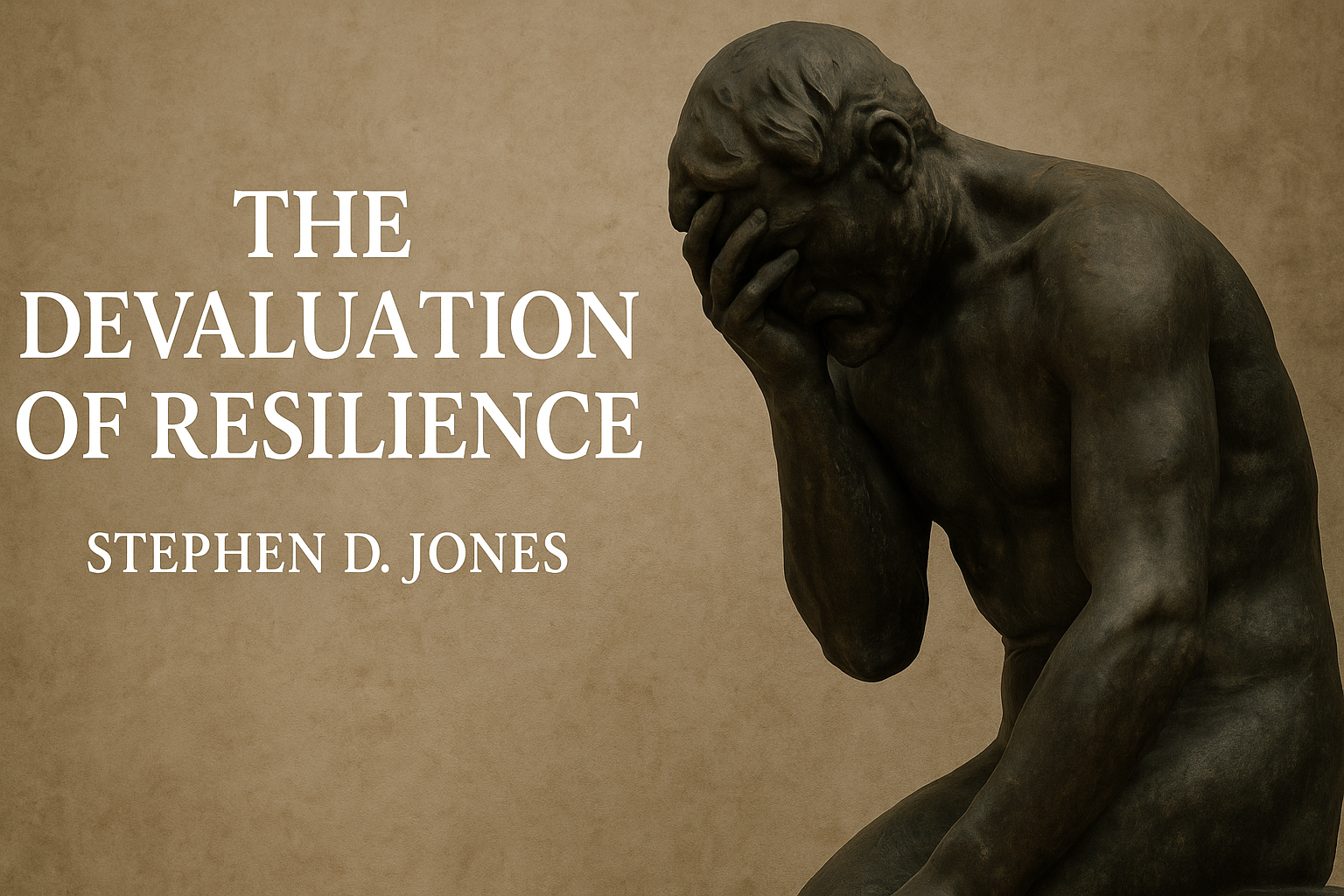
The Devaluation of Resilience
I. Introduction
We live in a world that is neither perfect nor fair. This is not a controversial observation, nor should it be. The history of our species is replete with adversity, and the evolution of our societies has always been marked by challenge. And still, we endure. Our capacity to suffer without disintegrating is one of the great quiet strengths of human nature.
Yet there is a growing discomfort in modern society when it comes to hardship. In our pursuit of comfort, we have developed a habit of flattening the spectrum of suffering. Mild discomfort is equated with genuine trauma, inconvenience with abuse, and embarrassment with psychological damage. It is not that modern challenges are illegitimate, but rather that they are often over-amplified. This is not to suggest that people aren’t in distress, only that the labels we apply to that distress matter. If we call every ache a wound, then we are left with no language for true injury.
This confusion, the inflation of trauma, reflects a culture that has become increasingly intolerant of hardship, even at its most mundane. But, from a human epistemological perspective, is this how we generally characterise suffering? In order to answer this question, it is beneficial to investigate the requirements that we rightly place on systems designed to operate in an imperfect world.
Part 15 of the FCC regulations for radio equipment states: A device complying with Part 15 must not only operate without causing harmful interference but also accept any interference received, even if it causes undesired operation.
Whilst these requirements are intended for radio equipment, and not thinking, feeling people, the comparison is apt because it demonstrates the solutions that we have created to ensure reasonable operation in an imperfect world; in the absence of feeling and sentiment. We may then rightly ask the question: Ought the situation to be different for human beings operating under similar conditions? And, if so, in what ways should we expect our behaviour to mirror the machine analog?
Should we, as individuals aiming to reach our highest potential, be expected to continue to strive even though conditions hinder our efforts? Ought we to attempt to inflict as little harm as possible on our fellows, even as they inflict harm upon us? The answer to these questions remains deeply personal, and each individual must find their own answers, and set their own boundaries. The degrees of resilience and virtue that will satisfy us vary greatly across individuals, and cannot simply be prescribed.
II. Hardships Recast
Today, people refer to being "traumatised" by a poor grade, a rude comment, or the absence of Wi-Fi. We have expanded the definition of trauma until it includes discomforts once seen as routine. The psychic immune system, like any system, weakens when it is underused. By demanding insulation from discomfort, we train ourselves to be less resilient.
There are, of course, real hardships that no one should be expected to shrug off lightly: the death of a parent, child, or spouse, debilitating illness, violent assault, or the crushing weight of poverty. But when these are placed on the same shelf as social awkwardness or workplace stress, the entire framework collapses. Sympathy becomes diluted, and the social apparatus designed to support those in need loses credibility.
This shift did not emerge in a vacuum. It has roots in a well-meaning but misapplied cultural movement: the rise of therapeutic language, the valorisation of emotional transparency, and a growing instinct to validate all expressions of distress equally.
Over time, this has created a perverse incentive structure; where victimhood can confer social capital, and where fragility is confused with authenticity. Instead of learning to endure discomfort, many are taught to externalise it, name it as trauma, and wait for validation. The result is a generation more fluent in self-diagnosis than self-discipline.
As an example, in online spaces, algorithmic feedback often rewards performative suffering with attention, while quiet perseverance goes unseen. This reinforces a strange economy, where fragility is a currency and endurance is invisible.
Whilst the intentions behind this cultural shift were ostensibly not malevolent, the results can still be. Consider the harsh puberty of the butterfly. When the butterfly is ready to emerge, it must laboriously push, squeeze, and struggle its way out of the confines of its chrysalis. This is a difficult and often prolonged process, and may appear unkind to the uninformed. This struggle, far from being a random obstacle, is a crucial part of its physical development. The act of pushing its way out forces vital fluids from its body into its wings. This hydraulic pressure is what expands, strengthens, and hardens the wings, preparing them for flight.
If a human, seeing the butterfly's apparent struggle, were to try to "help" by cutting open the chrysalis or cocoon to free it, the butterfly would emerge too easily. Its wings would remain weak, crumpled, and unable to properly inflate or harden. The butterfly would be unable to fly, and thus unable to survive for long in the wild. What we would have accomplished with our "help", in this case, would not have been a reduction of hardship, but rather a reduction in the ability to cope with it.
III. Historical Hardship
Now, human beings are neither butterflies nor transistor radios, yet there is sufficient similarity from which to infer analogy. Consider what was once endured without ceremony: sending children to war, surviving on food rations for years, losing multiple siblings to disease, living entire lives under authoritarian rule. These were not extraordinary traumas but the daily realities of existence for most of history. It is not a glorification of suffering to recall this; it is simply context.
If such analogy does indeed exist, then the question becomes: What is it, and how do we define it rationally, such that we may bound our own reasonable expectations of ourselves? The solution is not to toughen people blindly, but to remind them that strength is learned, not granted - and that the path to it, though difficult, is walkable.
People must be taught, ideally from a young age, that there are circumstances where avoidance of an obstacle is prudent, yet there are others where avoidance of the obstacle will bring measurable harm. We need to possess the skills required to be able to discern when the obstacle ought to be avoided and when confrontation will produce the better long-term outcome.
And how to acquire such skills in today’s world? The answer is as profoundly simple as it is unsatisfactory: We must, by degrees, learn to identify and label emotions accurately. It does not suffice when one's inner monologue states simply: "I am sad." We need to move past this point until we are able to quantify the sadness and discern from whence such sadness came. To do this, we must broaden the vocabulary of our inner monologues. This skill cannot be learned overnight, and its value cannot be overstated.
Once we know what we are feeling and why, we are able to move on to the next phase: Seeking out intentional, but manageable discomfort. This will de-sensitise us against hardship and allows us to learn, through effort and success, that the best outcomes must be earned. What happens when we refuse that path?
IV. Gains and Losses
By inflating trauma, we gain a sense of immediate importance. We are seen. We are validated. But what we lose is far greater: the capacity to suffer with dignity, the perspective to judge severity, and the strength that comes from enduring the unbearable.
There is a nobility in enduring pain without theatrics. There is wisdom in knowing which burdens are yours to carry, and which are not. And there is power in knowing that survival is not a fluke of privilege, but the product of character.
Being unfamiliar with pain and hardship will also limit our ability to sympathise, recognise, and react to the suffering we observe in those closest to us. If we construct a mental framework where everybody suffers, we will likely come to the subconscious conclusion that no suffering merits sympathy, because all suffering merits sympathy.
If we wish to live with clarity and be of service to our friends, families, and communities, then we need perspective. We need to understand the nature of suffering and hardship so that we might accurately recognise it in others. If we do not do this, then we will never even see the problem, let alone be able to take steps to remedy the situation.
And, if we wish to live honestly, we must internalise the fact that life is inherently neither fair nor just. This is a constraint placed upon us by reality and whilst you can ignore reality - you cannot ignore the consequences of ignoring reality. If suffering becomes universal, then it becomes meaningless - and those in true pain will go unheard amidst the noise.
V. Conclusion
It is not noble to collapse at the first sign of hardship. Nor is it shameful to endure more than one ought. Between these poles lies the reality of life. The human creature is not made for comfort; it is made for adaptation. We do not thrive by eliminating all hardship, but by becoming stronger than it.
Non est vivere sed valere vita est.
— Dr Stephen D. Jones
#Resilience #Perspective #Endurance #ModernCulture #Philosophy #MentalHealth #EmotionalIntelligence