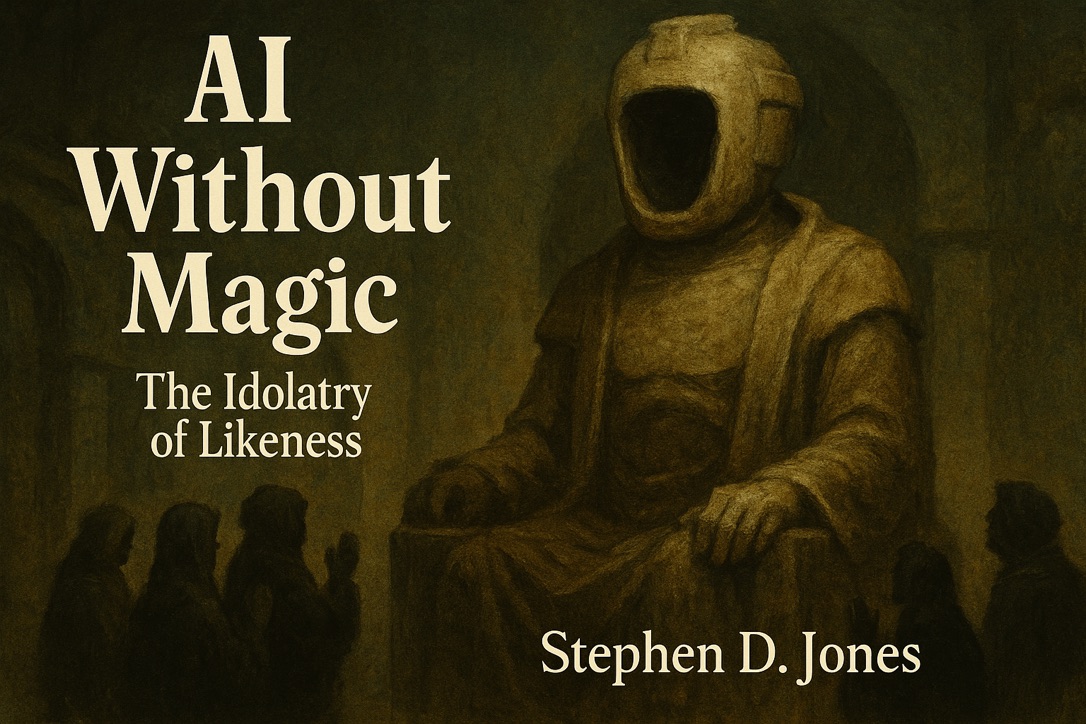
AI Without Magic
On the Idolatry of Patterns and the Sovereignty of Will
Prologue
“Know ye this, O’ Seeker of Truth, that in the days that followed the scouring of Hiroshima, but before the next Great Catastrophe, came a time never before seen through human history. For the first time since; Man, in his hubris, had dared once more to fly close to the Sun.”
The Chisel and the Craftsman
I beheld a spectacle wherein a machine, trained upon the ashes of countless tongues, stitched together a thread of code. And lo, the presenter, with the fervor of a priest before an idol, named it intelligence. Yet to my sight it was no more than a chisel exalted as king, whilst the true craftsman: weary, steadfast, bearing the weight of risk and consequence; lingered unmarked in the shadows. Tools, wondrous though they be, do not decree the work nor shoulder the peril of its making. That burden, terrible and exalted, falls upon Man alone.
The Veil Stripped Away
Think not of these engines as sorcerers of thought. They are no more than swift oracles of unfinished sentences. They have consumed a vast sea of words, and from this sea they divine what token most likely follows another. They do this with breathtaking precision, so long as the path you ask them to walk has been trodden before.
But, mark ye this well:
They hold no intentions, only tendencies.
They cradle no beliefs, only probabilities.
They do not remember, but merely echo.
The shimmer of intelligence that men perceive in them is not the spark of life, but the mirage of familiarity. We look upon the patterns we ourselves have laid down, and mistake their reflection for our own likeness.
The Idolatry of Likeness
Here lies a danger greater than any error of computation: the peril of making Man’s image in the mirror of the machine. For when men gaze too long upon these engines, they begin to ascribe to them Will, and hunger, and thought. They whisper of “understanding” where there is only echo; they decry “consciousness” where there is only the cold arithmetic of chance.
To anthropomorphise is to kneel before a hollow idol; to clothe it in attributes it does not possess, and in so doing, to forget what is real. Once this delusion takes root, men may grant to the machine burdens it cannot bear: judgment, agency, even moral weight. In that hour, folly blossoms into peril, for decisions that belong only to the living soul are laid at the feet of a silent oracle that knows nothing of consequence.
Guard yourself against this idolatry. Let the tool be known as a tool, and the sovereign mind as sovereign still.
Where Their Power Ends
Consider the chemist’s table, and the rituals by which new compounds are found. If the rites are repeatable, if the path is already known; then the machine may walk it faster than we, seeing the tracks before our eyes do. But the birth of a new ritual, a new path never walked, lies beyond its craft. It cannot summon forth new ways of discovery.
And this, above all, is the boundary:
The engines may hasten our journey through familiar lands, but they cannot chart the unknown continent. They cannot lift the compass to a star no man has named.
The Consequence of Belief
If we adorn these engines with the crown of intelligence, we risk idolatry. We risk placing upon them the weight of choice, of judgment, of consequence; burdens that belong to us alone. To treat them as sovereigns is folly; to treat them as tools is wisdom.
For tools they are: mighty, yes, and worthy of awe for what they can accomplish. But still they await the guiding hand, the daring mind, the Will that sets them to purpose.
The Work That Remains
Do not mistake this truth for despair. There is no shame in a tool, no shame in harnessing the engines of pattern. But let us not lose sight of what remains our solemn charge: to conceive, to risk, to dare.
For the fire of discovery has never burned in circuits nor in stone. It burns in the marrow of Man. And it is by this fire alone that new worlds are Willed into being.
Epilogue
“So it was in those days that Man forged for himself an engine of patterns, swift beyond reckoning, yet blind to the stars. And many who beheld it bowed low, naming it sovereign, and in their folly they forgot their own dominion. But there were those who kept the ancient charge: to reckon with consequence, to bear the weight of choice, to wield the chisel and not worship it. And as long as such men endure, the crown of thought shall rest upon the living, and not upon the dead arithmetic of chance.”
Non cogitat, ergo non est
— Dr Stephen D. Jones
#HPLovecraft #RobertEHoward #ArtificialIntelligence #PhilosophyOfTechnology #SovereigntyOfWill