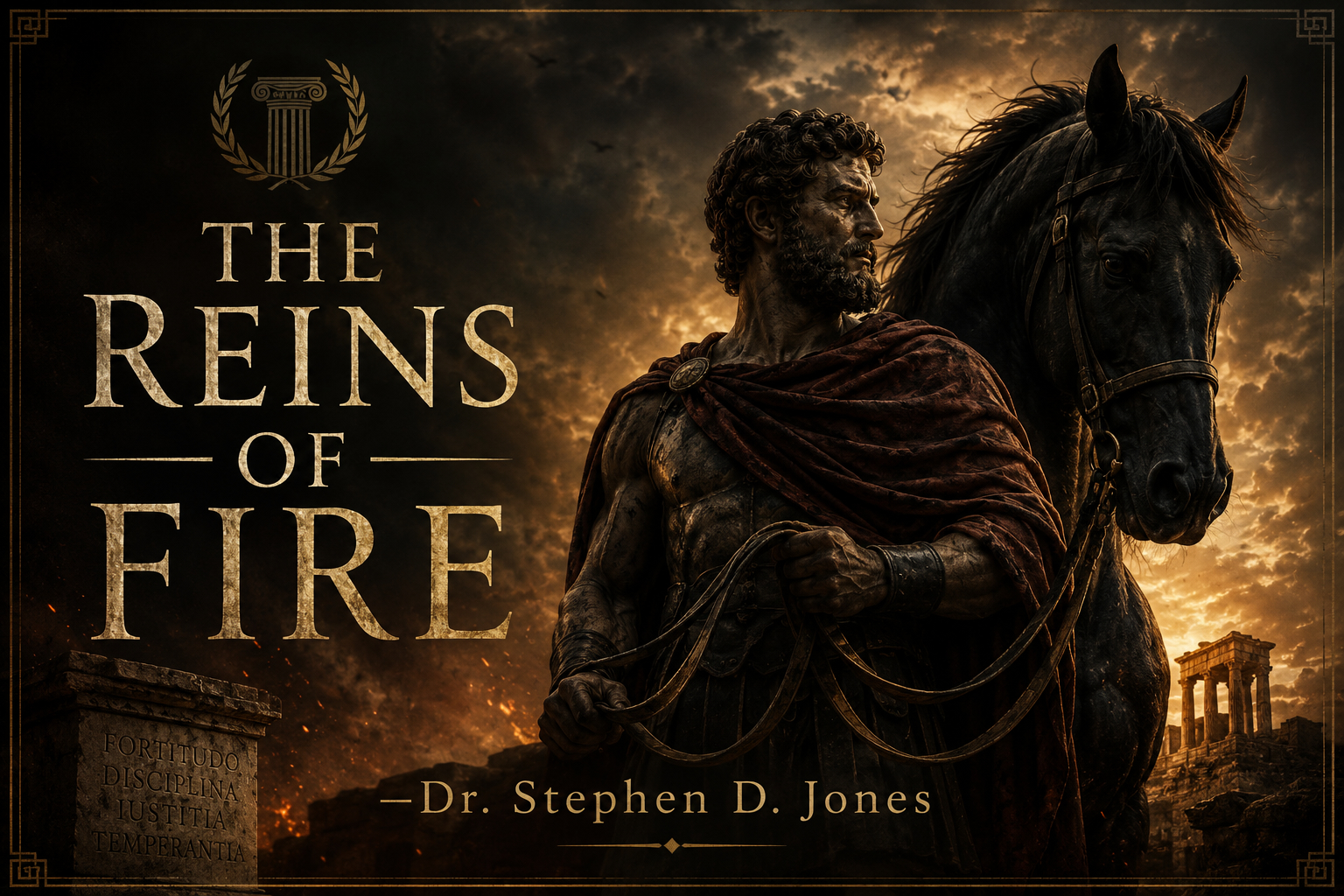
A Meditation on the Reins of Fire
There are some men who seem to be born with a fire in them.
I do not mean a noble fire only. That would be too easy. Too flattering. Too dishonest. I mean a fire that warms and burns, that protects and destroys, that gives colour to life and danger to the soul. The same force that can make a man loyal, passionate, brave, hard-working, and alive can also make him reckless, cruel, self-indulgent, or stupid. A red-blooded man may know this better than anyone. He may love deeply, work fiercely, defend what is his, and stand upright in the storm. Yet, somewhere inside him, there may also be a wild thing pacing the fence.
Sometimes that wild thing wants a cigarette.
Sometimes it wants a drink.
Sometimes it wants danger, speed, violence, lust, rage, or some small rebellion dressed up as freedom.
Sometimes it simply wants to break something so that the pressure inside has somewhere to go.
This is difficult to admit, because we would prefer virtue to be cleaner than this. We would prefer goodness to mean that the impulse has died. We would prefer to imagine that a good man no longer feels the pull toward self-destruction, cruelty, or foolishness. But this is not always true. Often the impulse remains. Sometimes it returns with old teeth. Sometimes it speaks in the voice of the father, the uncle, the grandfather, and every man before us who mistook appetite for identity.
The blunt truth is this: the impulse may never leave entirely.
But the impulse appearing is not yet the moral event. What we do next is the moral event.
A good man is not necessarily a man without destructive urges. A good man is a man who feels them rise and refuses to enthrone them. He does not say, “This is who I am, and therefore I must obey.” He says, “This is in me, but I remain sovereign.” That distinction may be the beginning of moral adulthood.
There is a difference between fire and wildfire. Fire in a hearth gives warmth. Fire in a forge makes steel. Fire in a lamp gives light. But fire without boundary consumes the house. The problem is not that there is fire in the soul. The problem begins when the heat seeks fuel among the people who trust us.
Every man who knows this fire must learn the reins. Not because he is evil, but because he is dangerous if he does not. A powerful horse does not become wicked because it wants to run. But if no one holds the reins, it can ruin the field, throw the rider, and break its own legs. So too with the force inside a man. It can carry him toward courage, discipline, labour, love, and protection. Or it can drag him toward ruin while telling him that ruin is freedom.
That is one of the oldest lies.
Self-destruction often disguises itself as freedom.
The cigarette says, “You are free.”
The drink says, “You are free.”
The cruel sentence says, “You are free.”
The reckless act says, “You are free.”
But we must ask, free from what? Free from duty? Free from restraint? Free from the expectations of those who love us? Free from the man we promised ourselves we would become? If so, then this is not freedom. It is merely another chain. Another lever by which we move toward the very worst versions of ourselves.
The urge usually offers relief. Not peace. Relief.
It says, “Do this, and the pressure will drop.”
Often, it is not entirely wrong. That is precisely why it is dangerous. The pressure may drop. The cigarette may soothe for five minutes. The drink may soften the edge of the evening. The cruel remark may discharge rage for three seconds. Recklessness may make the blood feel alive again.
But then the bill arrives. Sometimes the bill is not dramatic.
Sometimes no one leaves. No one shouts. No one names the wound aloud. Your wife still kisses you goodnight, but now she measures the weather in your face before she speaks. Your friend still answers your messages, but no longer brings you the tender thing he meant to say. Your child still loves you, but learns the old art of listening for danger in footsteps. The people around you may forgive you, may stay with you, may even understand you. But understanding is not the same as safety.
That is the part a man must fear. Not only that he may be hated for what he has done, but that he may be loved by people who have learned to protect themselves from him.
A man must decide whether he will pay the cost of discipline before the act, or the cost of regret after it. There is no free version. There is only choosing when the bill is paid. And, in time, all debts must be repaid in full.
So we tighten the reins.
When the old pull rises, we name it. We do not romanticise it. We do not flatter it. We do not call appetite “authenticity” or weakness “freedom.” We say: this is a surge. This is not a decision. This is pressure, not truth. It has entered the room, but it does not own the house. I remain sovereign.
And then we move toward the good.
Sometimes this means leaving the room. Sometimes it means running until the body remembers its place. Sometimes it means cold water, prayer, silence, sleep, food, labour, confession, or simply keeping one’s mouth shut until the cruel sentence has died unborn. Sometimes the highest act of virtue in a day is invisible. No one applauds the cigarette not smoked, the insult not spoken, the temptation not followed, the reckless road not taken. But these private victories are the foundation stones of a trustworthy life.
But restraint alone is not the whole of virtue.
A man cannot spend his life merely saying no to himself. No to the cigarette. No to the drink. No to the cruel sentence. No to the reckless road. These refusals are necessary, but they are not the final form of goodness. If all we do is bind the fire, then we may become resentful wardens of our own cage.
The fire must be given work.
Let it become labour. Let it become discipline. Let it become tenderness defended by strength. Let it become the patience to listen when pride wants to answer. Let it become the courage to apologise without demanding absolution. Let it become the force by which a man keeps his promises when no one would know if he broke them.
The aim is not to become harmless. A harmless man may simply be a man who lacks the strength to do damage. The aim is to become trustworthy with power. To be warm without burning. Strong without threatening. Passionate without becoming a tyrant. Fierce without becoming cruel.
The fire is not the enemy. The fire is the offering.
Yet we will not always win.
A meditation on goodness must leave room for the fall, because men fall. If we pretend otherwise, we write for angels and liars. We are not angels. We live in mud and blood, appetite and consequence. We may not like it, but reality cares little for our preference.
When we fall, the answer is not cheap self-forgiveness. “Forgive yourself and move on” can become moral laundering if it means that we merely feel bad, say a few gentle words to ourselves, and avoid looking closely at the machinery that produced the wrong. Wiping the blood from the blade while leaving the knife on the table is not repentance.
The better road is harder.
Tell the truth. Pay the debt. Understand the mechanism. Strengthen the wall of the Inner Citadel. Then return to the standard without theatrical self-hatred.
First, we name the wrong without euphemism. Not “I slipped.” Not “I was stressed.” Not “It just happened.” We say, “I chose this. I crossed a line. I let appetite outrank duty. I used pressure as an excuse.” We do this in the name of honesty, and deny ourselves the comfort that may come with indulgent self-abuse.
Then we repair what can be repaired.
If we have harmed another person, apology is necessary, but apology is not absolution. It is not a magic spell by which the past is rewritten. A cruel man who later regrets himself does not become less cruel in the past. Regret does not edit history. It either changes the future, or it is theatre.
A true apology does not say, “I am sorry, now release me.”
A true apology says, “I did wrong. I recognise what I did. I recognise that it harmed you. I will not minimise it. I will make what restitution I rightly can. I will change the thing in me that made this possible. What you do with that is yours.”
That last sentence is bitter medicine.
The wrongdoer must not expect absolution simply because he apologised. Forgiveness may come, or it may not. Trust may return, or it may not. The wounded person may accept the apology and still need distance. They may forgive and still never again feel safe in closeness. They may heal in a way that does not include us. If our remorse is real, we do not get to resent them for that.
Apology is not the purchase of forgiveness. It is the first honest payment toward repair.
The duty of the wrongdoer is restitution, not control. He must not try to fix the other person so that he can stop feeling guilty. He must not force conversations, demand closure, seek reassurance, or make himself the hero of their recovery. Sometimes the most moral thing he can do is remain available for rightful repair, while refusing to intrude upon their healing.
Some damage cannot be undone. It can only be honoured by never being repeated. Sometimes this must suffice.
This is a hard thing for the wrongdoer to accept, because remorse often wants a ceremony. It wants tears, forgiveness, reconciliation, and the comforting illusion that the story has been closed. But some stories do not close for the comfort of the one who broke them. Some apologies are accepted without intimacy returning. Some restitution is received without trust being restored. Some people will believe that we are sorry and still decide that they are safer elsewhere.
And they may be right.
But fire does not only live in the wrongdoer. Sometimes we are burned by the fire in another, and then we must decide what to do with the wound.
The wounded also have work to do.
This is unfair. Of course it is unfair. That is why it hurts. The first injury is the wrong itself. The second injury is that the burden of healing now falls upon the one who did not ask to be harmed. It is a double blow. A person is lied to, betrayed, abandoned, humiliated, or wounded, and then discovers that no apology, however sincere, can climb inside their chest and make them whole again.
If a drunk driver breaks my legs, it is his fault. He may owe restitution. He may owe confession. He may owe punishment. He may apologise until his throat is raw.
But I must do the rehabilitation.
That is grotesquely unfair.
It is also reality.
The driver cannot move my legs for me. He cannot rebuild the muscle. He cannot endure the pain of each small step on my behalf. Others may help. A doctor, a therapist, a friend, a spouse, a spiritual guide, a community. Healing need not be lonely. But the inner work cannot be outsourced.
So too with wounds of the heart.
The one who harmed me may be guilty of the wound. But if I make the wound my character, then that later labour is mine.
This does not excuse the wrongdoer. It does not pretend the wound was imaginary. It does not say, “Get over it,” which is often cruelty disguised as advice. It says something sterner and more merciful: what happened to me may explain me, but it must not govern me forever. I remain sovereign here also.
If someone lied to me fifteen years ago, I may truthfully say, “I struggle to trust because I was lied to.” That may be honest. But I cannot forever say to an innocent person, “I cannot trust you because someone else lied to me.” At some point, an innocent person is being asked to pay interest on a debt they did not incur.
The wound may not be my fault. The stewardship of the wound becomes my responsibility.
If I refuse that responsibility, I may become the thing that injured me, only with better excuses. The betrayed person becomes suspicious and controlling. The abandoned person becomes cold and unreachable. The humiliated person becomes cruel. The wounded man says, “I am only protecting myself,” while quietly turning everyone who loves him into a defendant.
And one day, if I am not careful, I may discover that I have become very fluent in the language of my own injury. I can explain my suspicion. I can defend my coldness. I can justify the tests I set for people who never harmed me. I can call it wisdom, standards, discernment, caution.
But if every innocent person must stand trial before the ghost of the one who hurt me, then I am no longer merely wounded. I have become unjust.
That is how pain reproduces itself.
The wrongdoer must not say, “I apologised. Your pain is your problem.”
And the wounded person must not say, “I was harmed. Therefore my harm gives me permission to harm in turn.”
They are not equal in origin, yet both can become self-indulgence if left ungoverned. Both can become evasions.
The guilty must make restitution.
The wounded must seek healing.
Neither is fair.
Both are necessary.
This is the shape of adult moral life. Not clean. Not sentimental. Not fair. Necessary, unforgiving, and real.
So the red-blooded man must learn to govern his fire before it burns others. And when he fails, he must tell the truth, make amends, and become harder to corrupt in the same way again. The wounded person must be granted anger, grief, distance, and time. But in the end, they too must decide whether the wound will remain an event in their history, or become the ruler of their soul.
There is no perfect innocence in this world. We harm. We are harmed. We fall. We rise. We apologise. We repair. We heal. We fail again. We return again.
Goodness is not proven by never feeling the pull of the lower thing. Sometimes goodness is proven in the private moment where the lower thing rises, and the higher thing remains in command.
The fire is real.
The reins must be real too.
And a good man may not be a man whose soul contains no wild horse, no old hunger, no inherited violence, no destructive whisper at the edge of thought.
Perhaps a good man is simply this:
A man who feels the horse surge beneath him, tightens his grip, remembers whom he loves, and refuses to let the animal choose the road. He understands that the people he loves should not have to become experts in surviving him. Perhaps that is enough.
Interdum quod amissum est recuperari potest. Interdum quod amissum est amissum manet. Noli absolutionem appetere.
Sometimes what has been lost can be recovered. Sometimes what has been lost remains lost. Do not crave absolution.
— Stephen D. Jones
#PhilosophyOfClay #SelfMastery #SovereignMind #SovereigntyOfWill #PersonalGovernance