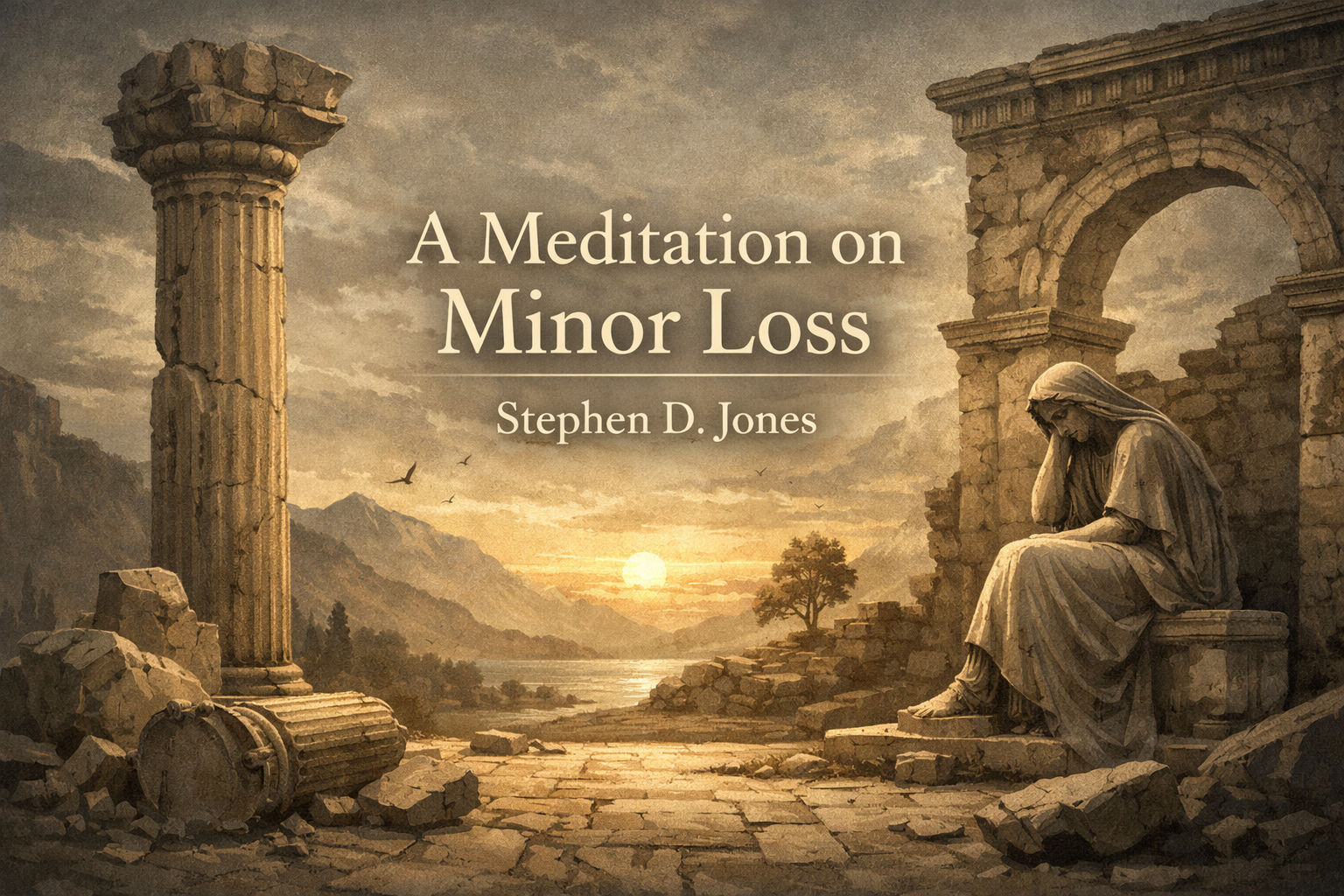
A Meditation on Minor Loss
There are losses that society permits us to mourn, and losses it expects us to swallow. Death is granted ceremony. Divorce is granted explanation. Disaster is granted sympathy. But there exists another kind of loss: common, quiet, and strangely sharp. This loss pains us also, but comes without permission to grieve.
A colleague takes a new job. A friend moves to another city. A team dissolves. Life rearranges itself, politely, and nothing “bad” has happened. No tragedy occurred. No villain can be named. And yet the chest tightens. The world feels thinner. The days become less inhabited. We miss someone who still draws breath, and we do not know what to call it. So we say nothing. We carry it, unspoken, until it fades or hardens. Until it becomes one more small, unnamed bruise that the adult is expected to ignore.
The reason this hurts is not mysterious, though it is rarely stated plainly: we are not a single personality moving through the world like a fixed statue. We are more like a living instrument, and different people draw different music from us. Around one person we are quick and playful. Around another we are thoughtful, disciplined, and exact. Some people summon our courage. Others soften us. Others call forth the strange, specific humour that seems to exist only in their presence. These are not masks in the dishonest sense. They are real selves. Real arrangements of our temperament made possible by real relationships.
And so when someone leaves, something more is lost than proximity. A particular version of the self loses its habitat. It becomes unreachable. It does not vanish from memory, but it vanishes from life. The “us” that existed between two people collapses, because it required both to exist. In this way, minor loss resembles the greater forms of grief: in kind, but not in magnitude. A continuity has been severed. A small world has ended. A life, even if only hypothetical, has been cut short. We feel this acutely, not because we are weak, but because we were many. And one of us is now gone.
This essay is a meditation on that quiet ending. On the grief we do not name. On the pain that is socially acceptable but privately sharp. And on what it means to live among others with enough honesty to admit that even small departures take something with them. And to demand, in return, that we learn how to carry what remains.
How the Self Becomes Plural
It is tempting to treat the plural self as a modern psychological curiosity, as though it were some quirk or feature of personality. I think it is older than that. I suspect it is ancestral. Something baked into the mammalian machinery long before any of us had language refined enough to describe it.
We are social creatures. Not merely in the casual sense that we enjoy company, but in the deeper sense that our survival once depended upon it. Long before the modern world made solitude possible, it was oftentimes lethal. To be ostracised was not to be lonely; it was to be exposed. It was to live knowing that the advantages of community would no longer be afforded you.
And so nature did what nature always does: it shaped minds that could bind together, coordinate, read faces, infer intention, mirror emotion, and maintain cohesion under stress. Nature, it would seem, intended for us to prevail through unity; and that, to the primitive man, division meant death.
The plural self is part of that design.
When we enter different social environments, we do not simply “act” differently. We tune differently. The mind adjusts its posture, humour, caution, openness, aggression, and even its softness. Around some people you become more curious. Around others you become more guarded. Around one group you are a teacher; around another you are a student; around another you are a protector. These shifts are adaptations: ways of becoming fit for the particular social terrain you are standing in.
This is social cohesion at work. A group cannot function if every person insists on expressing the full spectrum of their temperament at all times. Unity requires selective restraint and selective emphasis. It requires us to bring forward the parts of ourselves that harmonise with the moment, and to keep the dissonant parts sheathed. We do this instinctively because cooperation demands it of us. Even the simple act of conversation is a form of coordination: a mutual agreement to share attention, share meaning, and align our inner worlds just enough to move forward together.
And when we do unite, when trust forms and a shared rhythm sets in, we become something more than individuals standing shoulder to shoulder. We become a compound organism of sorts: a living structure that can carry burdens no single person could carry alone. Unity gives us courage. Unity gives us endurance. Unity gives us the strange strength of knowing that you are not facing the world as a solitary creature, but as part of a bonded whole. It is why our artifacts are found everywhere from the tallest mountain peaks of Earth to the airless plains of the Moon and the barren deserts of Mars. This is what unity means for us. It is real, even if we oftentimes choose not to talk about it.
This is why the loss of a relationship is not merely sad. It is destabilising. Something in the nervous system recognises that a piece of the structure has been removed. A route to safety has narrowed. A shared vigilance has ended. A familiar ally is no longer beside you. Even when the modern mind knows you will survive, the older machinery still registers the fracture. And it responds in the language it has always used: ache, anxiety, longing, grief.
Minor loss hurts because it is both emotional and structural. It is the mind noticing that one of its bonds, one of the very mechanisms by which humans become more than human alone, has been severed. It grieves, and why should it not?
The Unspoken Grief of Lost Access
Most people understand grief as the price paid for death. A person is gone, and the world must reconfigure itself around that absence. But there is another form of grief, quiet, socially inconvenient, and therefore often denied. It comes from a different kind of severing: not the end of a life, but the end of access.
When someone moves away, changes jobs, falls in love, becomes a parent, or simply drifts into a new season of life, they do not vanish from existence. They remain alive, and often reachable in principle. You can still message them. You can still see photographs of them smiling in new places. And yet you can no longer reach the relationship as it was. You cannot reach the shared rhythm. You cannot reach the ordinary closeness that once required no effort. You cannot reach the version of them that existed inside your shared world, and you cannot reach the version of you that lived there either.
In place of unity there is now division.
And you have been sundered.
This is why “keep in touch” so often fails. Because that which was lost was not just the simple exchange of information. It was proximity, routine, coincidence, and the effortless frequency that turns a connection into a lived reality. A relationship requires repeated contact, shared time, and the accumulation of small, mundane moments that slowly build a private world. It cannot survive solely on intention, no matter how much we wish it to be so.
When those conditions vanish, the relationship does not always end with a dramatic argument. More often it ends politely, quietly, by physics. The environment that kept it alive is removed, and what remains is a memory.
And because this kind of loss is not cleanly categorised, it often goes unacknowledged. There is no funeral. There is no socially accepted script for saying, “I am grieving the end of our everyday world.” To admit it can feel embarrassing, as though one is claiming tragedy where none occurred. So people minimise it. They call it sentimentality. They tell themselves they are being dramatic. They swallow the grief and continue with their day, carrying a quiet disorientation they cannot explain.
But the pain persists precisely because it is not imaginary. Your mind is registering a genuine change in reality: a pathway that once led somewhere warm now leads nowhere. A familiar door has been sealed. A part of your social world has become inaccessible, and with it, a part of your inner world becomes inaccessible also. You are not merely missing a person. You are missing a way of being alive that required that person’s presence.
This is why minor loss can feel so strange. The person is still “out there,” and yet the connection is not. The relationship has become a relic. Something you can remember, but no longer inhabit. And memory, for all its power, is not the same as access. Memory lets you relive; access lets you live again. When access is revoked, you feel the grief of a world that has ended, even if nobody died.
To call this grief “minor” is not to insult it. It is simply to distinguish it from catastrophe. It is grief without calamity; loss without disaster. And because it lacks the theatrics that society associates with mourning, it is often left unresolved. It lingers in the background like a low ache, shaping the way we trust, the way we attach, and the way we leave. Often without us ever admitting what it truly is.
Duties of the One Who Leaves, and the One Who Remains
If minor loss were merely a private feeling, it might be enough to name it and endure it. But it is not only private. It is relational. It is created between people, and therefore it carries moral weight. Not guilt, which is often theatrical and self-serving, but duty. A departure can be necessary, even righteous. And yet it still alters the inner lives of others. The Clay Man does not deny this simply because the departure is socially acceptable.
The Duty of the One Who Leaves
Leaving is not wrongdoing. People must grow. Families must be provided for. Opportunities must be taken. Seasons end. This is not a plea for stagnation, nor a romantic argument for loyalty at all costs. But if you leave people who cared for you, trusted you, leaned on you, or became part of your daily world, then you leave with a debt.
That debt is repaid by honour, not by self-sacrifice.
To leave honourably is to leave clean.
It begins with the simplest and rarest act: truth spoken to the face. Do not soften your departure into vagueness. Do not disappear behind corporate phrases and polite euphemisms. Do not pretend it will not hurt. Look those who will feel your absence in the eyes and tell them the truth: that you are going, that you did not arrive at this lightly, and that what you shared mattered enough to deserve an honest ending.
Then comes a second duty, more practical and therefore more meaningful: do not leave chaos behind you. The Clay Man does not vanish and call the resulting confusion “growth for others.” If you were a pillar in a structure, then removing yourself without strengthening what remains is negligence. You do not owe people your life, but you owe them a clean handover: knowledge transferred, responsibilities clarified, names put forward, doors opened where you can open them. If your departure is inevitable, then seek to make your absence survivable.
Finally, repay the debt of departure by not squandering the new chapter. When you leave, you take with you the investment others made in you: the time, patience, trust, laughter, instruction, tolerance, and belief. If you waste the opportunity your leaving created, you do not only betray yourself, you cheapen what others gave you. The leaver should strive to do well not merely out of base ambition, but out of respect. If your going caused pain, then let the outcome be worthy of the cost.
And carry them with you. Not as nostalgia, but as stewardship. Speak of them well. Remember what they taught you. Let your gratitude remain alive in action rather than speech.
This is emotional and spiritual hygiene: to refuse to treat people as disposable simply because life is moving.
The Duty of the One Who Remains
The duty of the one who remains is harder to describe, because it is less visible. It is the duty of inner governance.
First: do not lie about what you feel. Minor loss becomes corrosive when it is denied. When you pretend you are unaffected, you do not become strong, you become numb. And numbness is not strength. To acknowledge grief is to remain truthful; not to collapse. It is to honour reality instead of letting reality poison you quietly.
Second: do not convert pain into resentment. It is easy to treat a leaver as a traitor, because resentment offers a cheap sense of moral superiority. But most departures are not betrayals. They are the ordinary motion of life. To punish someone inwardly for choosing their path is to demand that they carry your fear for you.
This is possession, not love.
Third: reclaim agency. If the leaver was a stabilising structure in your world, their absence can feel like the ground giving way. But this is precisely the moment to become stronger rather than smaller. A person who must be present for you to function has become, however unintentionally, a kind of crutch. The Clay Man thanks the crutch, but learns to walk. You honour what the relationship gave you by becoming less dependent on any single person for your stability.
Fourth: keep what was good, and release what can no longer be lived. There is a difference between memory and access. You cannot keep the old world alive by force. But you can carry its best parts forward: lessons learned, standards raised, courage borrowed, softness discovered, humour unlocked. If a certain person brought forth something good in you, then prove their influence was real by keeping that goodness alive after they are gone.
And if you can muster the courage to speak it, speak it: tell them they mattered. Do this so that the circle is closed cleanly, and not to bind them with guilt. A clean ending is a gift to both sides. It prevents the relationship from decaying into vague silence and unspoken interpretations. It lets the symphony of the shared world end with dignity rather than silence.
The Shared Duty: To End with Respect
In minor loss, there is rarely a villain. There is only change. And change always costs something. The duty of both parties is to refuse the cowardice of pretending otherwise.
The one who leaves should not cause harm while pretending he is not doing it.
The one who remains should not deny harm in order to appear invulnerable.
Between those two forms of honesty, something becomes possible: grief that is real, but not ruinous; endings that are sad, but not bitter; and a kind of human continuity that survives the end of access.
Conclusion
Minor loss rarely arrives as a single, decisive blow. It arrives as weather. It is the slow attrition of endings that do not qualify for ceremony: the goodbye that is polite, the distance that grows by degrees, the familiar presence that becomes an occasional message, and then a memory. And because these losses are so often left unspoken, unnamed, unexplained, and unresolved, they do not simply vanish. They accumulate. They settle into us. They wear channels through the inner landscape the way water cuts into stone: through dogged, unrelenting persistence; not acute violence.
This is how a person can become harder without ever choosing to, and without being betrayed. By becoming eroded. Unpaid grief becomes a quiet tax on the spirit. It dulls the appetite for connection. It teaches caution where openness once lived. It makes a man flinch before he even knows he is flinching. In time, he may call this “maturity,” when it is only fatigue.
But there is another way to understand it, and it is the truer one.
This pain is the intrinsic cost of loving. The wound exists because something real existed. We grieve lost access because access once mattered. Because a shared world once warmed us. Because another person once helped summon a version of us that was worth being. To be capable of friendship, loyalty, admiration, kinship, and love is to accept that change will one day take its share. The price is not optional. Nor is it avoidable. It is the admission fee to a life that is fully human.
So let us not pretend we can avoid the cost. Let us instead pay it rightly.
Let the one who leaves do so cleanly: with truth, gratitude, and care for what remains.
Let the one who remains refuse denial, refuse resentment, and carry forward that which was good with honour rather than bitterness.
And when the ache comes, as it must, let us recognise it not as weakness, but as proof. Proof that we were many. Proof that we were joined. Proof that we lived among others and did not merely pass them like scenery.
This is the price we all must pay. Let us attempt to pay it rightly, if not always gladly.
Amor manet. Memoria manet. Manent in corde.
“Love remains. Memory remains. They remain in the heart.”
— Dr Stephen D. Jones
#PhilosophyOfClay #Grief #Friendship #Leadership #HumanCondition